Featured Post

Welcome to Our Website

       We started making plans for this lifestyle 3 years ago.  We looked at all the options for travel- including trikes, hotels and a RV. ...

Tuesday, October 17, 2023

Holiday Campground - Ochlockonee, Bay FL

Holiday Campground - Ochlockonee Bay, FL 

We are taking our time traveling the Florida Coastline- this is our second stop after Gulf Shores (technically in Alabama, but on the state line).  We are slowly learning how to slow down and smell the proverbial roses.  We decided Tuesdays will be our travel day.  We picked Tuesday as a travel day because its a day with the least amount of other people traveling. The days of the week are pretty irrelevant to us- we try to do the opposite of what people on vacation typically do. When the masses are on the beach, eating out, or shopping on the weekends, we try to steer clear of tourist attractions. We can make a mid week day be our Saturday.  We are still determined to keep our travel limited to a 5-6 hours maximum- which equates to 250-300 miles at a time.  Keeping it under 300 miles is very important to us. This not only makes the travel much easier, it also helps control costs. By traveling this way, we are able see and do more in more places with less travel costs. Another huge benefit of staying each place a week, you get a big price cut for a full week (often one day is free). We also feel less rushed to see and do everything in a few days. It is much more enjoyable to take our time and spend as long or as little time at a place as we want. It was wearing me out being in tourist mode, so rushed, busy and in perpetual go mode. I had COVID for over 6 weeks and it kicked my booty. Mark was only mildly sick for a few days. We started slowing things down after the COVID ordeal.

When we first started our adventure, we said it was more about the journey than the destination. This has proven to be more true than we ever imagined. Many of our best stays have been in little places we had never heard of before that are not typical tourist traps. We are not fond of the resort campgrounds- they tend to be cramped, crowded, treeless concrete parking lots and are always incredibly expensive. Our favorite campgrounds are COE property or state parks. We have even stayed in a few city parks. The campgrounds are radically different from the resort style. We can stay in COE campgrounds for over a week significantly cheaper than one day in the resort parks. The place we stayed in Key West cost more for one week than a month in the very best COE property. The other differences are even better than the cost savings- they are typically water front and the sites are exponentially larger with shade trees. We have stayed in several "nice/upscale resort campgrounds" but none of them are even in the same league as our worst COE park. We are always surprised at the number of people who know nothing about COE parks. We wish there were more COE parks in more areas. I definitely would love to stay in them exclusively every stop if we could. We cannot stay in the majority of national parks- our rig is literally too big and we do not fit. We no longer even look at campgrounds inside the national parks.


The Gulf fritillary, or passion butterfly, is a bright orange butterfly. They are referred to as "longwing butterflies", because they have long, narrow wings compared to other butterflies.

The Gulf Fritillary is most commonly found in the southern areas of the United States, specifically in many regions of Florida and Texas. We saw hundreds of them at that park. We are getting to be very good detectives curtesy of Google.


The St. Marks Light is the second-oldest light station in Florida. It is located on the east side of the mouth of the St. Marks River, on Apalachee Bay.

In the 1820s, the town of St. Marks, Florida was considered an important port of entry. The town served as a port for the prosperous planting region of Middle Florida and some counties of South Georgia. Growers hauled their agricultural products down to the port town in wagons by way of an early road which connected the former territorial capital of Tallahassee to the town of St. Marks. Later, this road would be widened and improved upon by the Tallahassee Railroad Company and would become the state's first railroad. The route was so critical, they named the road Tamiami (short for Tallahassee to Miami). That road is still a main thoroughfare through town. 

Once the agricultural products reached the new port town, they were loaded aboard boats for shipment to New Orleans and/or St. Augustine. However, there were problems in navigating both the Apalachee Bay and the St. Marks River. In many places both bay and river were shallow, and it was not uncommon for boats to run aground and/or get mired in the muddy shallows.

In May 1828, the U.S. House of Representatives passed an act which authorized the construction of a lighthouse at St. Marks and appropriated $6,000 for its construction.

After a survey was completed of the St. Marks area by Robert Mitchell, the Collector of Customs at Pensacola, and a site chosen for the lighthouse, it was discovered that the initial construction sum of $6,000 would be insufficient. The appropriation was increased to $14,000.

Calvin Knowlton was brought in to build the tower. He oversaw its completion in 1831. That same year, the tower's whale-oil lamps were lit for the first time by Samuel Crosby, who had been appointed the first Keeper of the St. Marks Lighthouse the previous year.

The lighthouse was automated by the United States Coast Guard in 1960, and in 2000 the Coast Guard spent $150,000 to stabilize the lighthouse. In 2000, the lighthouse's fourth-order Fresnel lens was deactivated and a modern solar-powered beacon was placed outside the lantern room. The historic Fresnel lens remained in place in the tower for over a decade. In July 2005, Hurricane Dennis broke a window of the lantern and flooded the inside of the tower.

In October 2013, the Coast Guard deactivated transferred ownership of the lighthouse to the United States Fish and Wildlife Service, which operates the St. Marks National Wildlife Refuge. In October  2019, a replica of the original fourth-order Fresnel lens was lit in the tower. The light is now maintained as a private aid to navigation and is lit seasonally.

You have seen a lot of lighthouses when you can identify the type of Fresnel lens by sight in the various lighthouses.


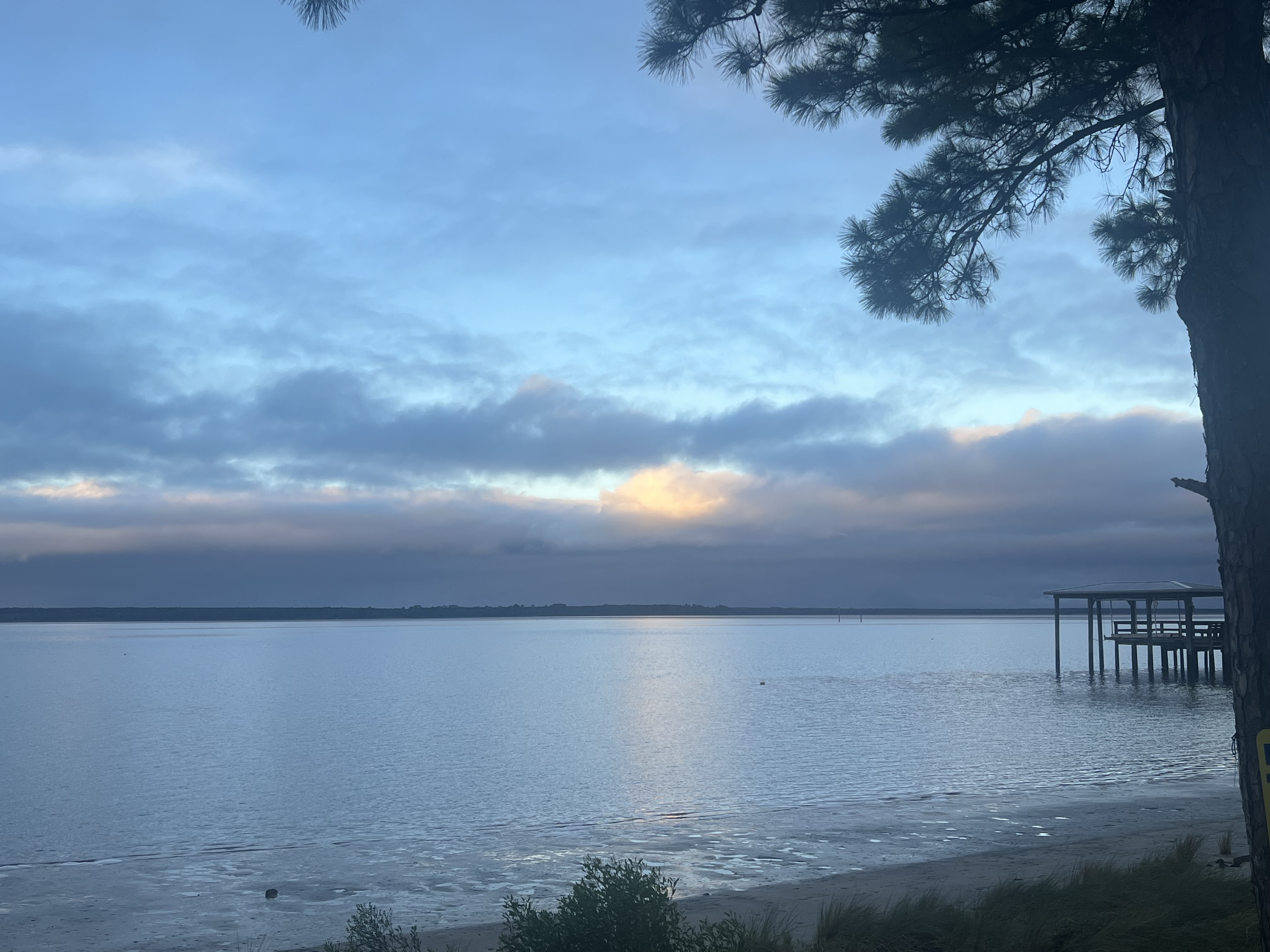


We had such an amazing view from our campsite which backed up to the bay. We love sitting outside, drinking coffee, listening to the waves and fish splashing around, while watching the yachts come in and out of the locks on the dam. This morning "coffee break" ritual has become our favorite way to start our day.  There was an incredible number of fish jumping out of the water. I squeezed in some great rock polishing time while watching the fish and the boats and rocking in my rocking chair. Anyone who has known me more than 5 minutes would never have predicted me happy as a clam, sitting in a rocker and grinding rocks with rock dust head to toe. I find the tranquility of the water to be the world's greatest Prozac. It relaxes me and gives me a sense of peace and calm that I cannot adequately express in words.  


Tuesday, October 10, 2023

Gulf Breeze RV Resort- Gulf Shores, AL


Gulf Breeze RV Resort- Gulf Shores, AL

USS Alabama (BB-60) is a retired battleship which was manned by a crew of 2,500 during war time. She was the fourth and final member of the South Dakota class of fast battleships built for the United States Navy in the 1940's. The first American battleships designed after the Washington treaty system began to break down in the mid-1930s.  They took advantage of an escalator clause that allowed increasing the main battery to 16-inch  guns, but Congressional refusal to authorize larger battleships kept their displacement close to the Washington limit of 35,000 long tons. A requirement to be armored against the same caliber of guns as they carried, combined with the displacement restriction, resulted in cramped ships. Overcrowding was exacerbated by wartime modifications that considerably strengthened their anti-aircraft batteries and significantly increased their crews.

After entering service, the Alabama was briefly deployed to strengthen the British Home Fleet, tasked with protecting convoys to the Soviet Union. In 1943, she was transferred to the Pacific for operations against Japan; the first of these was the Gilbert and Marshall Islands campaign that began in November that year. While operating in the Pacific, she served primarily as an escort for the fast carrier task force to protect the aircraft carriers from surface and air attacks. She also frequently bombarded Japanese positions in support of amphibious assaults. She took part in the Mariana and Palau Islands campaign in June–September and the Philippines campaign in October–December. After a refit in early 1945, she returned to the fleet for operations during the Battle of Okinawa and the series of attacks on the Japanese mainland in July and August, including several bombardments of coastal industrial targets.

The Alabama assisted in Operation Magic Carpet after the war, carrying some 700 men home from the former war zone. She was decommissioned in 1947 and assigned to the Pacific Reserve Fleet. She remained there until 1962 when she was stricken from the Naval Vessel Register with plans to demolish and scrap the parts. After requesting custody of the USS Alabama, the state of Alabama was given its namesake to refurbish and maintain as a museum.

Since 1965, the retired battleship USS Alabama has been in Mobile, AL as a National Historic Landmark open to the public as a museum.  Several movies have used it as the set for military movies- including Under Siege and Men of Courage. In 1969, The USS Drum was decommissioned and brought to the park to be cradled next to the USS Alabama. She is the oldest American submarine still open to the public as a museum.

Obviously, visiting this museum was high on our must do list. There was no way we were leaving Mobile, AL without spending a (full) day touring the boats and the memorial park which honors all veterans and branches of the military. It is likely one of the best memorial parks we have ever visited. There is even a smaller replica of the Veteran Memorial Wall in Washington, DC.  Thank goodness I carry snacks in my purse, because I ended up needing a few of them. After a long day in the military museums, Mark treats me to a Mexican dinner so I can have my favorite meal (fajitas). This compromise works well for us. We both enjoy these museums and memorial parks, but Mark obviously has a much deeper connection. This memorial park scored bonus points by having a submarine included in the tour. Every time we tour a submarine, it becomes much more obvious there was no way in heck I could have spent 12 hours, much less 12 years, on one of them. Kudos to Mark and his submariner buddies for being hearty enough to patrol the seas to protect our country. We are eternally grateful to all veterans for their service- to the ones who gave and the ones who gave all.


Lisa was standing in front of the USS Alabama on our way to start the tour. Recall it consisted of a crew of 2,500 men during wartime. You have to pack and carry a ton of food and supplies to house that many people and be battle ready for combat.


The entry door to the Battle Bridge obviously was not built for big bulky men. I had to duck down to climb through the door.  Mark and his Lapon buddies were a bit smaller, more physically fit and much more nimble in their 20's than they are now. I am not sure how many of them could still get  through the small openings found throughout a submarine at a full run. It would be an interesting challenge to watch though..... I would even volunteer to be a medic just to get a front row seat for the entertainment.


Lisa was looking in awe as she stood between the anchor chains on the bow. This was definitely not a chain you can buy at Home Depot.  So many of the things aboard a military vessel are so much larger and more highly technical than most civilians can even fathom. It is very impressive when you consider they designed and built these highly technical beasts without computers using tools which were significantly inferior to the tools we presently use.


The Alabama's battle history during WWII is depicted in bronze at the memorial.


USS Alabama's awards and the battles it supported are commemorated on the bridge wings of the ship. Each military vessel has some memorial of the awards it earned in combat placed in or on the vessel. Safety for the crew and vessel dictate placement of the memorial. A submarine is successful because of its ability to hide from the enemy. A colorful display on the outside would be visible and interfere with its ability to remain hidden, which would endanger the crew. The awards earned by a submarine are placed on a removable plaque to assure safety for the crew and the vessel. The current costs to build a battleship or submarine are estimated to be between $6.4 -12.3 BILLION in 2023. Safety of the crew is paramount, but the vessels require protection as well.


USS Alabama had 4 of these 5 bladed screws (propellers) weighing in at 18.5 tons each and measuring  17' 4.5" in diameter. These propellers could propel the ship at 25 knots. Nautical miles are different than miles on land. To convert nautical miles to miles, you multiply the length value by 1.151. So 25 nautical miles is equal  to 28.769 miles on land. One nautical mile equates to exactly one minute of latitude,   __________________________________________ 


In June 1944, while on her eighth patrol, the USS Herring with her entire crew of 88 souls were lost at sea following a Japanese attack off the coast of Matua Island. Not only was this the Herring's last patrol, it was also its most successful patrol. She is credited with sinking a total of 9 enemy ships during her service.  In 2016, her wreckage was located near Matua Island by a joint expedition of the Russian Geographical Society and Russian Defense Ministry. It was reported that "Russian divers in cooperation with the Pacific Fleet sailors discovered the submarine at a depth of 104 meters [341 ft]." The wreckage was discovered but never recovered. The sailors the USS Herring remain on eternal patrol buried with the wreckage.

USS Drum (SS-228) is a Gato-class submarine of the United States Navy. It was the first Navy ship to be named after the drum, a type of fish. The Drum is now a museum ship in Mobile, Alabama, at Battleship Memorial Park.

The Drum was the twelfth of the Gato class but was the first completed and the first to enter combat in World War II. She is the oldest of her class still in existence.

USS Drum received a total of 12 battle stars for her World War II service. She is credited with sinking 15 ships, for a total of 80,580 tons of enemy shipping, eighth highest of all US submarines in total Japanese tonnage sunk.

The Drum was donated and then towed to the USS Alabama Battleship Commission in 1969. The Drum was dedicated and opened to the public on 4 July 1969.

The submarine was declared a National Historic Landmark in 1986.

The Drum was moored in the waters behind the USS Alabama, until she was substantially damaged by the storm surge of Hurricane George in 1998. As a result, she is now on display on shore. The Alabama and the Drum also sustained damage when Hurricane Katrina came ashore in  August 2005. Following extensive restoration, tours on board the Drum were resumed in January 2006. Most funding to maintain the submarines comes from a community of past and present  American Submarine Vets.


   And then we said goodbye to the Battleship Memorial Park in pursuit of some amazing combo fajitas. 
                         I can usually be persuaded into about anything with the promise of fajitas. If you                          upgrade them to combo fajitas (chicken, steak and shrimp), then you are sure to persuade me.
                                              Never underestimate the power of bribery.

Tuesday, October 3, 2023

Poches RV Campground- Breaux Bridge, LA

Poches RV Campground- Breaux Bridge, LA

The Tribute to Courage monument is a statue of Sam Houston located in Huntsville, Texas (where Sam Houston lived and died), which is 65 miles north of the city of Houston. Sam Houston is one of the founding fathers of Texas. He led the army of Texas during their War for Independence from Mexico in 1836, including the victory at San Jacinto (about 100 miles from the statue) where Texas won her independence by defeating Mexican President Santa Ana in the field. The statue by sculptor David Adickes is 67 feet tall and was built in 1994. It is clearly visible to motorists heading north on Interstate 45. It is the ninth-tallest statue in the United States.


 Within 10 minutes after arriving at the campground, Karma decided it was time to go for a swim and jumped in. We were lucky enough to get a waterfront RV site again.  We were backed right up to the water and Karma absolutely loves playing in the water. We tease and say he identifies as a Labrador, even though he is not a very good swimmer.  The water was a little bit stagnant where he decided to go for a swim. Luckily, the water did not smell as badly as I feared, nor were the mosquitos too bad.  Karma on the other hand, did not smell very good after his swim. He definitely had that wet dog odor.
_______________________

Baton Rouge is the capital city of Louisiana. Since 2020, it has been the second-largest city in Louisiana after New Orleans.  Baton Rouge is the fifth most populous city proper in the Deep South region of the southeastern United States.
The Baton Rouge area owes its historical importance to its strategic site upon the Istrouma Bluff, the first natural bluff upriver from the Mississippi River Delta at the Gulf of Mexico. This allowed development of a business quarter safe from seasonal flooding. In addition, it built a levee system stretching from the bluff southward to protect the riverfront and low-lying agricultural areas.

Baton Rouge has developed as a culturally rich center, with settlement by immigrants from numerous European and African nations brought to North America as slaves or indentured servants. It has been ruled by seven different governments: French, British, and Spanish in the colonial era; the Republic of West Florida; the United States as a territory and a state; the Confederate States of America; and the United States again since the end of the American Civil War. Throughout the governance of these various occupying national governments of Baton Rouge, the city and its metropolitan area have developed as a multicultural region practicing many religious traditions from Catholicism to Protestantism and Louisiana Hoodoo. 


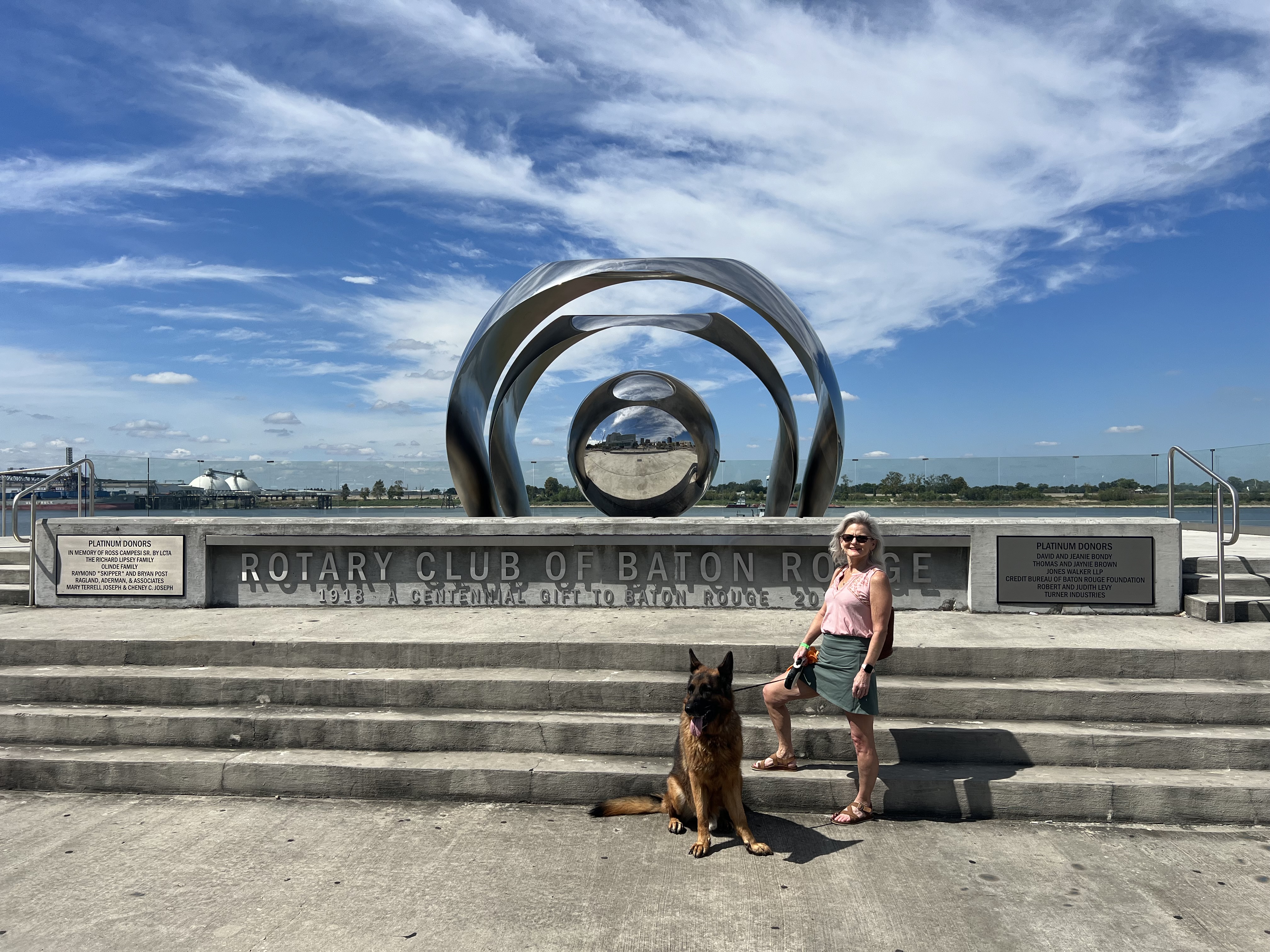
Louisiana is home to the mouth of the mighty Mississippi River. Now Baton Rouge can claim home to the river’s eye.

“It’s a lens to the city because it’s reflective back and to the river which this city was born from.”


We watched the many barges moving north on the Mississippi River. It is still a main highway to transport goods.


USS Kidd (DD-661), a Fletcher-class destroyer, was the first ship of the United States Navy to be named after Rear Admiral Isaac C. Kidd, who died on the bridge of his flagship USS Arizona during the 1941 Japanese attack on Pearl Harbor. Admiral Kidd was the first US flag officer to die during World War II and the first American admiral ever to be killed in action. She remains a National Historic Landmark, she is now a museum ship, berthed on the Mississippi River in Baton Rouge, and is the only surviving US destroyer still in her World War II configuration.

Kidd (DD-661) was launched in February 1943 in KearnyNew Jerseysponsored by Mrs. Isaac C. Kidd, widow of Rear Admiral Kidd. The destroyer was commissioned in April 1943. During her initial cruise to the Brooklyn Naval Shipyards, she sailed across New York Harbor with the Jolly Roger flying from the foremast. Subsequently, during outfitting, her crew adopted the pirate captain William Kidd as their mascot and commissioned a local artist to paint a pirate figure on the forward smokestack.

She departed for the Pacific in August 1943 in company with the battleships Alabama and South Dakota. Arriving at Pearl Harbor in September 1943, she was soon put to work escorting aircraft carriers toward Wake Island for the heavy air attacks conducted in October on Japanese installations located there, returning to Pearl Harbor on 11 October 1943.

On 11 April 1945, Kidd and her division mates, BlackBullard, and Chauncey, with the help of Combat Air Patrol, repelled three air raids. That afternoon, a single enemy plane crashed into Kidd, killing 38 men and wounding 55. As the destroyer headed south to rejoin the task group, her fire drove off further enemy planes that were trying to finish her off. Stopping at Ulithi for temporary repairs, she got underway on 2 May for the West Coast, arriving at Hunter's Point Naval Shipyard on 25 May.

On 1 August 1945, Kidd sailed to Pearl Harbor and then she returned to San Diego, California 24 September 1945 for inactivation. She was decommissioned on 10 December 1946 and entered the Pacific Reserve Fleet.

The Kidd is the first ship we have toured that was not in the water but sitting on dry dock keel blocks. 


In the heart of Louisiana’s capital city, there is a large memorial to veterans in all branches from all wars fought by Americans. One section of the Riverfront pays tribute to Louisiana natives who died in the service for their country.  The memorials black Granite walls are inscribed with over 7000 names from the Revolutionary War to the present (excluding Civil War names) the memorial's eternal flame rests in the center of the square, overlooked by seven American Flags.


The Old Louisiana State Capitol, also known as the State House, is a historic government building, and now a museum, in Baton Rouge. It housed the Louisiana State Legislature from the mid-19th century until the current capitol tower building was constructed from 1929-32.

It was built to both look like and function like a castle which has led some locals to call it the Louisiana Castle, the Castle of Baton Rouge, the Castle on the River, or the Museum of Political History; although most people just call it the old capitol building.

In 1846, the state legislature in New Orleans decided to move the seat of government to Baton Rouge. As in many states, representatives from other parts of Louisiana feared a concentration of power in the state's largest city. In 1840, New Orleans' population was about 102,000, making it the fourth-largest city in the U.S. The 1840 population of Baton Rouge, on the other hand, was only 2,269.

In September 1847, the city of Baton Rouge donated to the state of Louisiana a $20,000 parcel of land for a state capitol building. The land donated by the city for the capitol stands high atop a bluff facing the Mississippi River, a site that some believe was once marked by the red stick, or baton rouge, which French explorers claimed designated a Native American council meeting site.

New York architect James H. Dakin (then living in New Orleans) was hired to design the Baton Rouge capitol building. Rather than mimic the national Capitol Building in Washington, as so many other states had done, he conceived a Neo-Gothic medieval-style castle overlooking the Mississippi.

Mark Twain, however, as a steamboat pilot in the 1850s, loathed the sight of it, "It is pathetic... that a whitewashed castle, with turrets and things... should ever have been built in this otherwise honorable place."

In 1862, during the Civil War, Union Admiral David Farragut captured New Orleans, and the seat of government retreated from Baton Rouge. The Union's occupying troops first used the capitol building — or "old gray castle," as it was once described — as a prison, and then to garrison African-American troops under General Culver Grover. While used as a garrison the building caught fire twice. This sequence of events transformed Louisiana's capitol into an empty, gutted shell abandoned by the Union Army.

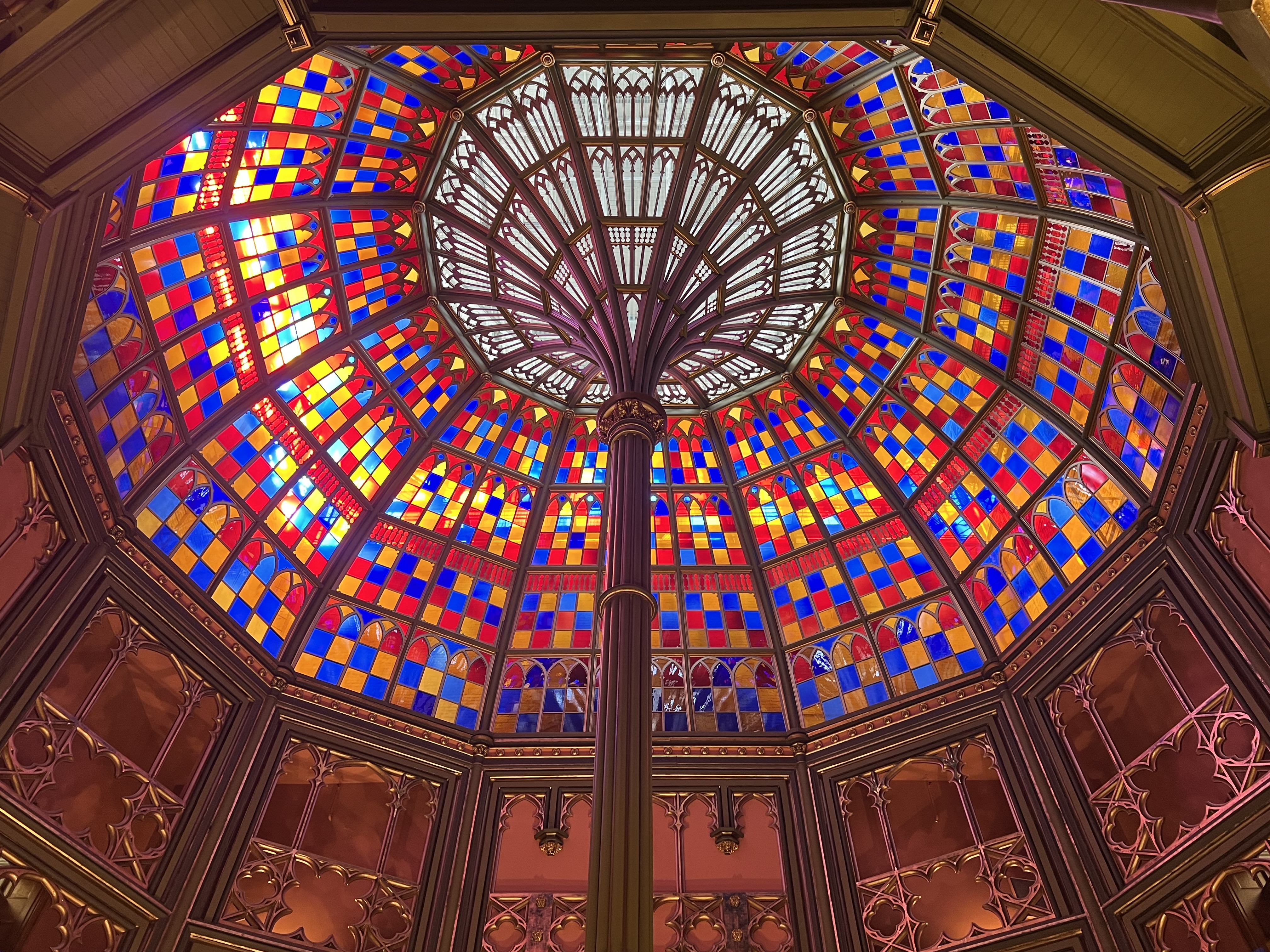
By 1882, the statehouse was totally rebuilt by architect and engineer William A. Freret, who is credited with the installation of the spiral staircase and the stained-glass dome, which are the interior focal points. The refurbished statehouse remained in use until 1932, when it was abandoned for the new Louisiana State Capitol building.

Restored in the 1990s, the Old State Capitol is now the Museum of Political History.


A Live Oak tree proudly sits on the original Capital grounds with her arms outstretched. These trees are so regal and impressive as their branches reach out protectively to give shade to a large area.


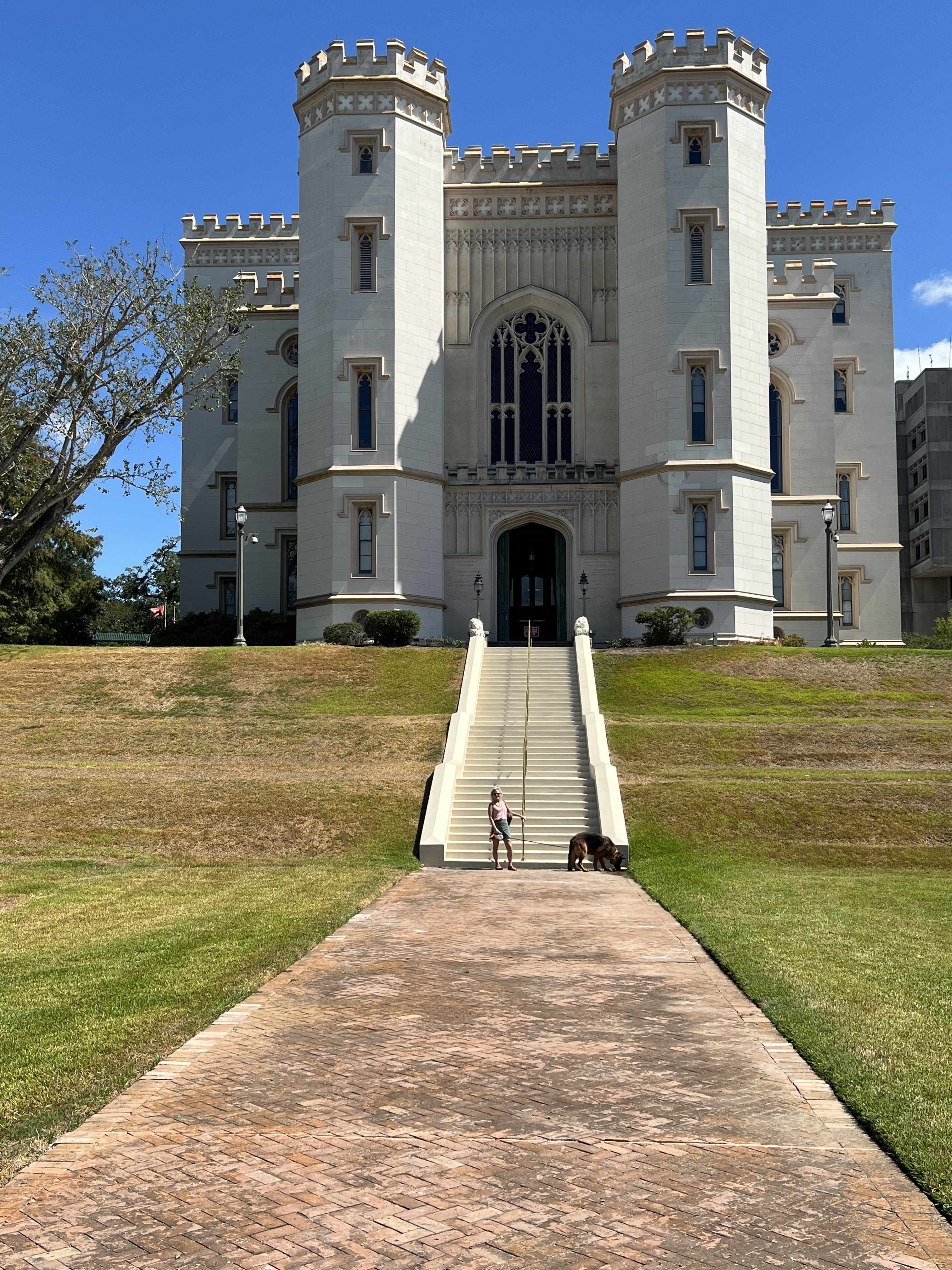
Lisa was standing in front of the stairs to the Original Capital Building. It was horribly hot outside. It looks like she was in a hurry to get some where with air conditioning. She was already in the lobby by the time I caught up with her.


This stained glass window brings beauty to the Senate.


Another stained glass window adorns the House of Representatives.


The stained glass in the dome in the center of the State House is the largest and most impressive piece of artwork in the capitol building.


The restoration of the building was performed so meticulously that even the reproduced hinges were manufactured from the same company to hang the doors. We had a very pleasant long chat with a gentleman who has volunteered as a docent with his wife for over 20 years. We met her at the welcome station to the museum. They had extensive knowledge of the history of the building and the people from that era associated with the capitol. They seemed to truly enjoy sharing their knowledge to improve the guests visit. We definitely learned and noticed so much more than we would have done had we toured the museum without meeting him. He pointed out so many interesting things we most likely would not have even noticed. They have been doing this for free for over 20 years. I wish we had asked their connection to the capitol that triggered their interest and dedication. I assume there was some personal connection for them to remain this enthusiastic and dedicated. 


This is the new capital building built to replace the original State House in 1930.
_________________

We found Louisiana's Gratitude/Merci Train. This is our third one out of the remaining 47. We only have 44 more to find.


He needed one last swim before we left in search of our next adventure.