Stage Coach RV Park- St Augustine, FL
St. Augustine was founded in 1565 by Spanish explorers. It is the oldest continuously
inhabited European-established settlement in what is now the contiguous
United States.
Spain ceded Florida to the United States in 1819, and St.
Augustine was designated the capital of the Florida Territory upon
ratification of the Adams–Onís Treaty in 1821.
We watched turkeys from the campsite in the mornings before we had our breakfast. We enjoy sitting outside having our coffee in the mornings. Granted, Mark is typically on cup #2 before Lisa ever gets up.....

We were in historic downtown St Augustine. We tried to enroll Karma at the school, but we were out of luck. The enrollment period had passed a few hundred years ago. We were too late. The town is actually very dog friendly. There were dog water bowls all over and several places gave him treats. There is a dog treat store just past this schoolhouse. We went inside and Karma marched himself right up to the staff behind the counter. He was poking his nose around inside a box of stuff. The lady asked me what his name was, so I told her. She busted out laughing when I told her. She picked up what he was poking at- it was a Christmas ornament with his name on it. Of course we had to buy it for him. She gave him a treat and he promptly sat down and wanted more. After she gave him a few treats, he went over to the other lady and sat beside her with his paw up. He was milking the free treats for all it was worth. We went back to the area the following night to see the city lit up at night (they had something insane like 3 million lights). Guess where Karma wanted to go? Yep, back to the treat store. The funny thing was they remembered his name. And yes, he got many treats from both employees.
While we were in the treat store, we met a couple with the most gorgeous Newfoundland dog. They have FIVE of them they travel with in their RV. The dogs all weigh between 90-160 pounds. They were in town for their dogs to march in the Christmas parade with their Newfoundland group. There are 63 of them in town for the parade. Of course, we had to go to the parade the next day to see the dogs.
The Cathedral Basilica of St.
Augustine is a historic cathedral and the seat of the Catholic Bishop of St. Augustine.
Construction took over five years (1793–1797), it was
designated a U.S. National Historic Landmark in 1970. Its congregation, established in 1565, is the oldest Christian
congregation in the contiguous United States.
We were standing in front of the Constitution Monument. A lady stopped and offered to take our picture. We have been blessed to meet some really nice folks during our journey.
Statue of Juan Ponce De Leon was erected here based on the idea he landed near this spot.
We were told to try the Oreo beignets with white chocolate bourbon sauce with a drizzle of chocolate syrup by a gentleman with a dog we met. He is a local who walks his dog daily through the historic district. He asked if he could give Karma a few treats and we ended up talking to him for about 30 minutes. He suggested a waterfront New Orleans style restaurant- he liked the beignets and they allowed dogs. We actually had a really good seafood pasta dish there and the beignets were awesome. The boudin balls and seafood dip weren't bad either. He had us interested as soon as he said it was New Orleans styled. Granted, it was not the same as the food in the Quarter, but it was pretty good. The food in NOLA is definitely Mark's favorite. He already has our next visit there scheduled, mainly so he can eat his fill.

The St. Augustine Light Station is a privately maintained active, working lighthouse.
The current lighthouse stands at the north end of Anastasia Island and was built between 1871-1874. The
tower is the second lighthouse in St. Augustine, the first being lit
officially by the American territorial government in 1824 as Florida's
first lighthouse. However, both the Spanish and the British governments operated
a lighthouse here, including a series of wooden watch towers and
beacons dating from 1565.


Photios I was
the ecumenical patriarch of Constantinople from 858-867 and from
877-886. He
is recognized in the Eastern Orthodox Church as Saint Photios
the Great.
Photios is widely regarded as the most powerful and influential
church leader of Constantinople subsequent to John Chrysostom's
archbishopric around the turn of the fifth century. He is also viewed as the
most important intellectual of his time – "the leading light of the
ninth-century renaissance". He was a central figure in both the conversion
of the Slavs to Christianity and the Photian schism, and whose
"collection in two parts...formed and still forms the classic source
of ancient Church Law for the Greek Church."
Photios was canonized by the Eastern Orthodox Church in 1847.
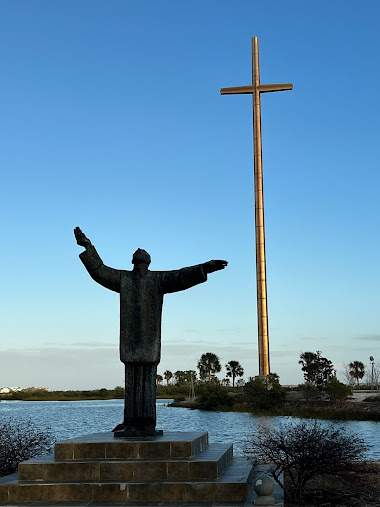

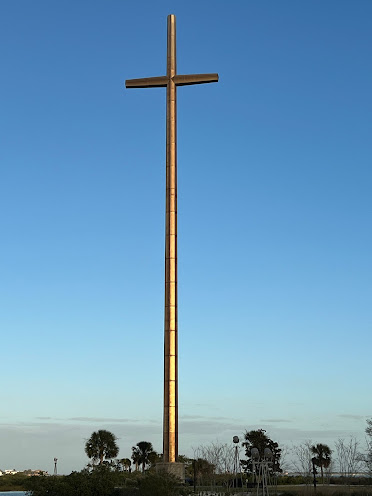
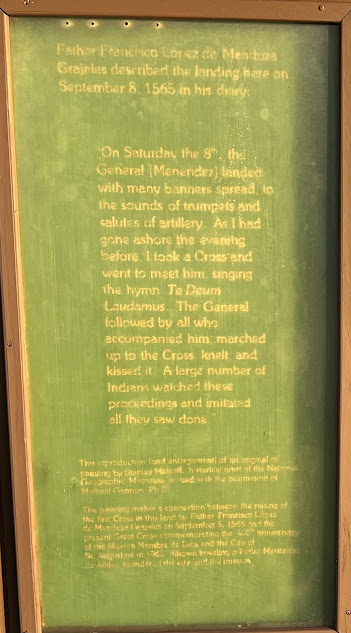


Spanish explorers, under
the command of Pedro Menéndez de Avilés and the spiritual chaplaincy
of Fr Francisco López de Mendoza Grajales, arrived in northern
Florida in 1565. Grajalez celebrated the first Mass in what would become
the United States. The mission established there, Nombre de Dios, was
also the first in that regard.
The settlers brought with them the Spanish devotion to Nuestra
Señora de La Leche y Buen Parto ("Our Lady of the Milk and Good
Delivery"). The name comes from the image of the Blessed Virgin Mary nursing
the infant Jesus, hence the reference to "la leche"—i.e.,
(breast) milk.

The brown
anole, also known commonly as the Cuban brown anole. The species
is native to Cuba and the Bahamas. It has been widely introduced
elsewhere, via the importation and exportation of plants where the anole would
lay eggs in the soil of the pots, and is now found in Florida and as
far north in the United States as Southern Georgia.
This species is highly invasive. In
its introduced range, it reaches exceptionally high population densities, is
capable of expanding its range very quickly, and both outcompetes and consumes
many species of native lizards, like the green anole. The brown anole's
introduction into the United States in the early 1970s has altered the
behavior and negatively affected populations of the native Carolina anole (known
as the green anole), which have since generally been relegated to the treetops.
This particular Anole was molting is skin.

Fort Matanzas was built by
the Spanish in 1742 to guard Matanzas Inlet which could be used as a rear entrance to the city of
St. Augustine. Such an approach avoided St. Augustine's primary defense system,
centered at Castillo de San Marcos. In 1740, Gov. James Oglethorpe of Georgia used
the inlet to blockade St. Augustine and launch a thirty-nine-day siege.
St. Augustine endured the siege, but the episode convinced the Spanish that
protecting the inlet was necessary to the security of the town. Engineer
Pedro Ruiz de Olano, who had worked on additions to the Castillo de San Marcos, designed
the fortified observation tower. Convicts, slaves, and troops from Cuba were
used as labor to erect the structure, which was sited on present-day
Rattlesnake Island and
had a commanding position over Matanzas Inlet.
The fort, known to the Spanish as Torre de Matanzas (Matanzas
Tower, is a masonry structure made of coquina, a common
shellstone building material in the area. The
standard garrison of the fort was one officer in charge, four infantrymen, and
two gunners, though more troops could be stationed if necessary.
In 1742, as the fort was nearing completion, the British under
Oglethorpe approached the inlet with twelve ships. Cannon fire drove off
the scouting boats, and the warships left without engaging the fort. This
brief encounter was the only time Fort Matanzas fired on an enemy.
These views are from the top of the fort overlooking the channel.
St Augustine Nights of Lights.
During the holidays, St. Augustine becomes a truly magical place with millions of tiny white lights adorning the city. Holding the distinct honor as one of the 10 Best Holiday Displays In The World by National Geographic, this year celebrating the 28th anniversary of this event.
There must be something about Christmas trees and blue lights. We have pictures of Lisa in front of one in Gatlinburg when we were there years ago.
Karma is sleeping at Buffalo Wild Wings after walking on the St Augustine Beach. Ironically, out of the four occupied tables on the patio, three were Eagles fans. Mark ended up having some guys to watch football with and drink a few beers. Karma wore himself out running and playing on the beach. The beach is one of his most favorite places on earth. We love it when the weather is good enough for us to sit on patios so he can go with us to eat. He really does not care where we go or what the weather is like as long as he gets to go with us. He will just lay here at our feet until we are ready to leave.


